
Caffeine is the most widely used cognitive performance compound in the world, and coffee is its primary delivery vehicle for working professionals. Research shows that workers consuming 220 mg or more of caffeine daily experience 50% fewer cognitive failures and workplace accidents. That single finding reframes coffee from a comfort habit into a performance tool. For professionals and remote workers in Iskandar Puteri navigating long desk hours and back-to-back meetings, understanding how to use coffee strategically is the difference between grinding through the afternoon and finishing strong.
1. How coffee productivity at work actually works
Caffeine blocks adenosine receptors in the brain. Adenosine is the chemical that builds up during waking hours and signals fatigue. When caffeine occupies those receptors, alertness increases and reaction time improves. The effect is real, but it is not unlimited. Research confirms that caffeine benefits repetitive, sustained attention tasks far more than creative problem-solving. If you are writing reports, reviewing data, or handling client emails, coffee works well. If you are trying to brainstorm a new product concept, the benefit is smaller than most people assume.
The practical takeaway is to match your coffee intake to your task type. Schedule caffeinated work sessions around focused, detail-heavy tasks. Reserve open-ended creative work for periods when caffeine levels are lower and your mind is less narrowly focused.

2. Timing your coffee intake for peak focus
When you drink coffee matters as much as how much you drink. Cortisol, the body's natural alertness hormone, peaks within the first 30–60 minutes after waking. Drinking coffee during that window wastes the caffeine because your body is already alert. Delaying caffeine intake 90–120 minutes after waking aligns with the natural drop in cortisol and produces a noticeably stronger effect.
The human body also runs on ultradian rhythms, roughly 90-minute cycles of high and low mental energy. Timing your coffee to the start of a high-energy cycle compounds the benefit. Many professionals find that a cup between 9:30 AM and 11:00 AM, and another between 1:30 PM and 3:00 PM, fits naturally with these cycles.
Key timing principles to follow:
- Skip the first-thing-in-the-morning cup. Wait at least 90 minutes after waking before your first coffee.
- Align with your peak work blocks. Drink coffee 15–20 minutes before a demanding task, not during it.
- Set a caffeine cutoff. Stop consuming caffeine by 2:00 PM if you sleep at 10:00 PM, or by 1:00 PM if you are sensitive to its effects.
- Track your response. Tools like the Make10000Hours productivity tracker help you log energy levels against caffeine timing to find your personal sweet spot.
Pro Tip: Even 200 mg of caffeine consumed at 3:00 PM reduces deep and REM sleep quality without necessarily delaying how fast you fall asleep. Protect your sleep to protect tomorrow's performance.
3. Choosing the best coffee for focus and sustained energy
The best coffee for work is not the strongest coffee. The optimal caffeine dose for cognitive enhancement sits between 75 and 200 mg per serving, roughly equivalent to one to three cups of brewed coffee. Doses above that range increase anxiety and reduce the precision of attention rather than sharpening it.
Brewing method changes the caffeine content significantly. A standard 8-ounce filter coffee contains roughly 95 mg of caffeine. A double espresso contains around 120–140 mg in a much smaller volume. Filter coffee is generally the better choice for sustained work focus because it delivers caffeine more slowly and pairs with higher water intake.
Coffee quality also matters. Specialty-grade beans, particularly light to medium roasts, retain more chlorogenic acids and antioxidants than dark roasts. These compounds contribute to the mood-stabilizing and anti-inflammatory effects that support longer cognitive sessions. Cheap, over-roasted coffee delivers caffeine but strips out much of the secondary benefit.
- Filter coffee delivers steady caffeine with lower acidity and more antioxidants per cup.
- Espresso-based drinks are effective but easy to over-consume due to their small volume.
- Cold brew has higher caffeine concentration per ounce. Measure carefully.
- Light to medium roasts preserve more beneficial compounds than dark roasts.
Pro Tip: If you are sensitive to caffeine or prone to afternoon jitters, green tea is a reliable alternative. It delivers L-theanine alongside caffeine, which smooths the stimulant effect and reduces anxiety without sacrificing alertness.
4. How workplace coffee solutions boost team productivity
On-site specialty coffee programs produce measurable results. Office coffee programs reduce break duration by 70%, leading to a 15% increase in productivity and a 20% drop in stress levels. Those are not small margins. For a team of ten professionals, that time savings compounds into hours of recovered focus each week.
The data on external coffee runs reinforces this. On-site specialty coffee reduces external coffee run time by 25%, saving 20–30 minutes per employee per day. That time adds up to roughly two full working hours per week, per person.
| Metric | External coffee run | On-site coffee station |
|---|---|---|
| Average break duration | 20–30 minutes | 6–9 minutes |
| Productivity impact | Neutral to negative | 15% increase |
| Stress effect | No change | 20% reduction |
| Job satisfaction boost | Minimal | 10% increase |
Coffee quality also shapes team culture. Better quality coffee keeps 82% of employees happier, and 40% say it directly motivates their productivity. A well-stocked coffee station is not a perk. It is infrastructure for performance.
For office managers in Iskandar Puteri, the implementation is straightforward. Invest in a quality grinder and brewer, source from a specialty roaster, and place the station in a social area that encourages brief, natural interaction between colleagues. The social ritual around coffee breaks builds team cohesion without requiring structured team-building activities.
5. Managing caffeine tolerance to sustain your productivity gains
Caffeine tolerance is the silent killer of coffee's productivity benefits. Habitual caffeine users develop tolerance within 2–3 weeks, at which point the cognitive boost shrinks significantly. The mechanism is biological. The brain grows more adenosine receptors in response to chronic caffeine exposure, requiring more caffeine to produce the same effect.
The solution is cycling. A five-days-on, two-days-off pattern resets adenosine receptor sensitivity and restores caffeine's effectiveness. Many professionals find that weekends are the natural window for this reset, though the first day off often brings a mild headache and reduced energy.
Strategies to manage tolerance effectively:
- Cycle your intake. Take two consecutive caffeine-free days each week to reset receptor sensitivity.
- Keep doses consistent. Avoid escalating your dose when tolerance builds. That path leads to dependence, not performance.
- Stay within the 75–200 mg range per serving. Exceeding this ceiling increases anxiety without improving focus.
- Watch your sleep. Tolerance-driven dose increases often push caffeine later into the day, compounding sleep disruption.
- Hydrate between cups. Caffeine is mildly diuretic. Dehydration mimics fatigue and leads to unnecessary extra cups.
The goal is not maximum caffeine consumption. The goal is the minimum effective dose that keeps your cognitive performance sharp throughout the workday.
6. Practical coffee habits for professionals and remote workers
Remote workers face a specific challenge. Without the social structure of an office, coffee consumption can drift into a constant, untracked habit. That pattern accelerates tolerance and disrupts sleep without delivering proportional focus benefits.
A few habits that work well in practice:
- Set two defined coffee windows. Morning (around 9:30 AM) and early afternoon (around 1:00 PM) cover the two main productivity peaks without pushing caffeine too late.
- Pair coffee with a task commitment. Before you pour a cup, name the specific task you will work on. This links the ritual to focused output rather than passive consumption.
- Use water as a reset. Between coffee windows, drink water. Thirst is frequently misread as fatigue, which leads to unnecessary caffeine.
- Build a coffee ritual. The act of preparing coffee, grinding beans, and waiting for a brew creates a brief mental transition that signals the brain to shift into work mode. That ritual effect is real and worth preserving.
The mood and stress benefits of coffee are also underrated. The aroma of freshly brewed coffee alone has been shown to reduce stress markers. For remote workers in Iskandar Puteri working from home or a co-working space, a quality coffee setup is one of the lowest-cost investments in daily wellbeing and focus.
Key takeaways
Coffee productivity at work peaks when professionals combine precise timing, quality brewing, and managed tolerance into a consistent daily routine.
| Point | Details |
|---|---|
| Time your first cup carefully | Wait 90–120 minutes after waking to align caffeine with your natural cortisol drop. |
| Stay within the effective dose range | 75–200 mg per serving maximizes focus without triggering anxiety or jitteriness. |
| Cycle caffeine to prevent tolerance | Take two caffeine-free days per week to reset adenosine receptor sensitivity. |
| On-site coffee saves measurable time | Workplace coffee stations save 20–30 minutes per employee daily and reduce stress by 20%. |
| Match coffee to task type | Caffeine sharpens sustained attention tasks. It adds less value to open-ended creative work. |
What I have actually learned from years of caffeinated work sessions
The conventional advice on coffee and productivity gets one thing consistently wrong. Most of it focuses on how much to drink and ignores when and why. I spent years treating coffee as a reflex, a cup at 7:00 AM because that is what you do, another at 2:00 PM because the afternoon slump hit. The results were mediocre. The moment I started treating caffeine as a timed intervention, everything shifted.
The 90-minute delay after waking felt counterintuitive at first. You wake up groggy and the instinct is to reach for coffee immediately. But waiting through that initial cortisol spike and drinking coffee as it fades produces a noticeably cleaner, longer-lasting alertness. I have tracked this pattern consistently and the difference is real.
The tolerance issue is the part most professionals ignore until it is too late. When your third cup of the day stops doing anything, that is not a sign you need a fourth. That is a sign you need two days off. The reset is uncomfortable but it works. After a caffeine-free weekend, Monday morning's first cup hits with the clarity of your first week of coffee drinking.
The last thing I would say is this: the environment where you drink coffee matters. A good cup in a focused, well-designed workspace compounds the cognitive benefit. A bad cup at a cluttered desk undermines it. The ritual and the setting are part of the performance equation.
— Dan
Where Theupperroom fits into your coffee and focus routine
Professionals in Iskandar Puteri looking to combine quality coffee with a focused work environment have a specific option worth knowing about. Theupperroom is a specialty co-working space in Johor built around a points-based, pay-as-you-use model. Members buy points and spend them on desk time, meeting rooms, and specialty coffee from The 18 Roasters, one of the region's respected specialty roasters.
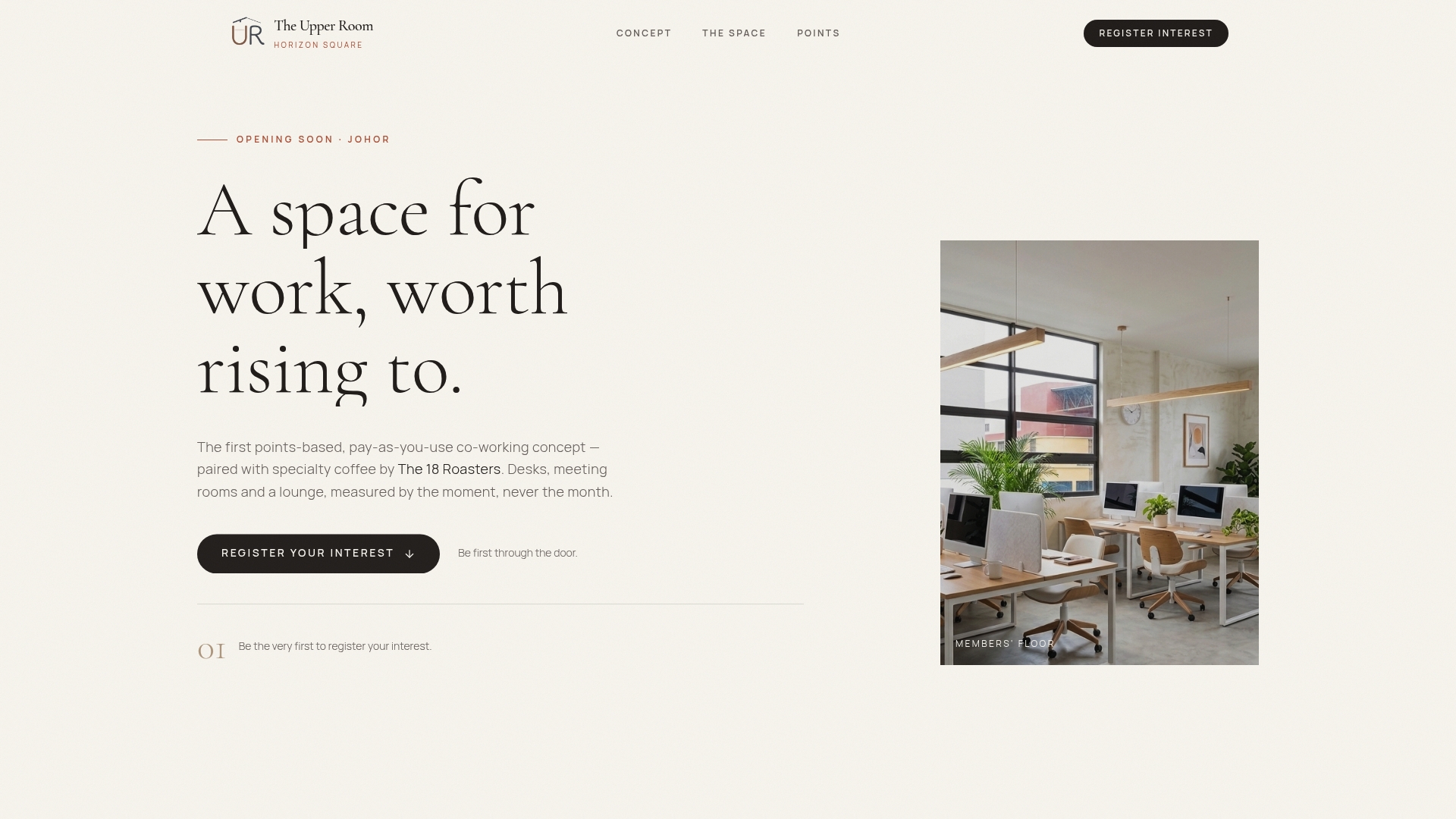
There are no monthly commitments and no wasted spend. You use what you need, when you need it. For remote workers who want the productivity benefits of an on-site specialty coffee workspace without locking into a fixed lease, Theupperroom is built for exactly that use case. The coffee is not an afterthought. It is part of the workspace design.
FAQ
How much caffeine should I drink for work focus?
The optimal dose for cognitive performance is 75–200 mg per serving, roughly one to three cups of brewed coffee. Exceeding this range increases anxiety without improving focus.
When is the best time to drink coffee for productivity?
Waiting 90–120 minutes after waking before your first cup aligns caffeine intake with your natural cortisol drop and produces stronger, longer-lasting alertness.
Does coffee help with all types of work tasks?
Caffeine primarily sharpens sustained attention tasks like data review, writing, and detailed analysis. Its benefit for open-ended creative thinking is limited.
How do I stop coffee from losing its effect over time?
Tolerance builds within 2–3 weeks of daily use. A cycling strategy of five days on and two days off resets adenosine receptor sensitivity and restores caffeine's cognitive benefit.
Does late-day coffee hurt productivity the next day?
Yes. Even 200 mg of caffeine consumed at 3:00 PM disrupts deep and REM sleep without necessarily delaying sleep onset, reducing next-day cognitive performance.