
Hybrid work in Malaysia is defined as a flexible working arrangement that combines scheduled office attendance with remote work days, giving professionals structure without sacrificing flexibility. The Malaysian government made this official when the Cabinet approved the Hybrid Working Day policy in june 2026, mandating 2 remote days and 3 office days weekly for civil servants starting August 1, 2026. A Ministry of Human Resources study found that 81% of Klang Valley workers report improved job performance under flexible work. That number signals a workforce ready to commit to hybrid as a long-term standard, not a temporary fix. For professionals in Johor, where commuting between Iskandar Puteri, Johor Bahru, and surrounding areas adds real daily costs, hybrid work is not just convenient. It is financially and professionally significant.
1. What is hybrid work in Malaysia, and how does it differ from full remote?
Hybrid work sits between full-time office attendance and fully remote work. The key difference is intentional structure: hybrid workers commit to specific in-office days rather than choosing day-by-day.
Full remote work eliminates the office entirely. Hybrid work keeps the office as a collaboration anchor while freeing up other days for focused, independent work from home or a coworking space. For Malaysian professionals, this distinction matters because flexible work arrangements under the Employment Act 1955 cover both models, but employers treat them differently in practice.

Industries best suited for hybrid work in Malaysia include finance, technology, consulting, education, and government services. Manufacturing and frontline healthcare roles remain largely office-bound or site-dependent, though administrative functions within those sectors can go hybrid.
2. The Malaysian civil service hybrid model
The civil service model is the clearest benchmark for hybrid work in Malaysia. Effective August 1, 2026, all civil servants follow a 2-day remote, 3-day office weekly schedule. Cabinet approved this arrangement in june 2026 after months of pilot reviews.
One scheduling detail that affects cross-state teams: office attendance days align with each state's official rest day schedule. This matters in Johor, where the weekend falls on Friday and Saturday, unlike the Sunday rest day in most other states. Teams coordinating between Johor and Kuala Lumpur need to account for this when scheduling shared office days.
The civil service model gives private-sector employers a ready-made reference point. Many companies in Johor and the Klang Valley have adopted a similar 3-plus-2 split as their default hybrid structure.
| Hybrid model | Remote days | Office days | Best for |
|---|---|---|---|
| Civil service standard | 2 | 3 | Government agencies |
| Private sector flexible | 1–3 | 2–4 | Tech, finance, consulting |
| Project-based hybrid | Variable | As needed | Creative, project teams |
| Coworking-anchored | 3–4 | 1–2 | Freelancers, small teams |
3. Your legal right to request flexible work
Employees in Malaysia have a formal legal right to request flexible work arrangements under Sections 60P–60Q of the Employment Act 1955. Employers must respond in writing within 60 days. They can reject the request, but they must provide written grounds for the refusal.
This is a right to request, not a guaranteed right to receive. Understanding that distinction helps you frame your proposal more effectively. A well-structured request that addresses business continuity, measurable output, and communication availability is far harder to reject than a vague ask for "more flexibility."
When you submit a hybrid work proposal, include a draft schedule, a list of tools you will use to stay reachable, and a suggested 30-day trial period. Employers respond better to specifics than to open-ended arrangements.
Pro Tip: Frame your hybrid work request around output metrics, not hours. Propose weekly deliverables and a check-in cadence. This shifts the conversation from "where you work" to "what you produce," which is the argument most likely to succeed.
4. How to negotiate and implement hybrid work effectively
Start with a written proposal. Outline your role's tasks, identify which ones require in-person presence, and show which ones you can complete independently. This analysis does most of the persuasion work before you even sit down with your manager.
Trial periods and iterative reviews are the most effective way to establish a hybrid arrangement that sticks. A fixed 30-day or 60-day trial with agreed review criteria gives both sides an exit if the arrangement does not work, which paradoxically makes managers more willing to say yes.
Time management in a hybrid setup requires deliberate scheduling. Block deep-focus work on remote days and schedule meetings, collaborative sessions, and face-to-face check-ins on office days. This prevents the worst hybrid outcome: spending remote days on calls and office days on solo work, which eliminates the benefit of both.
Communication tools matter more than most professionals expect. Platforms like Microsoft Teams, Slack, and Google Meet are table stakes. What separates productive hybrid teams from struggling ones is how they use those tools: clear response-time norms, documented decisions, and shared project boards that keep everyone aligned regardless of location.
5. Technology and coworking spaces for hybrid workers in Johor
Digital tools form the backbone of any hybrid setup. Video conferencing, cloud document storage, and project management platforms remove the friction of working across locations. The tools themselves are widely available. The discipline to use them consistently is the real differentiator.
Coworking spaces fill a specific gap that home offices cannot: professional infrastructure, reliable internet, and a separation between work and personal life. Coworking spaces in Johor have expanded significantly to meet demand from hybrid workers, remote employees, and small business teams who need a professional environment without a full-time lease.
When choosing a coworking space, evaluate these factors:
- Internet reliability: Minimum 100 Mbps symmetric for video calls and file transfers
- Meeting room access: Private rooms for client calls and team sessions
- Flexible booking: Pay-per-use or points-based models beat rigid monthly contracts for hybrid workers
- Community: Spaces with active member communities generate referrals and collaboration opportunities
- Location: Proximity to your home or clients reduces the commute burden that hybrid work is meant to address
Pro Tip: Visit a coworking space during peak hours before committing. A space that feels calm during an off-peak tour may be overcrowded and noisy on a Tuesday morning. Most spaces offer day passes. Use one before signing up.
6. Benefits and challenges of hybrid work in Malaysia
The productivity case for hybrid work in Malaysia is now backed by data. 64.4% of workers report that working from home makes their jobs easier. That finding reflects a genuine shift in how Malaysian professionals experience their work, not just a preference for comfort.
The financial case is equally strong. Prime Minister Anwar Ibrahim has urged private-sector adoption of flexible work specifically to reduce fuel consumption and ease cost-of-living pressure. For professionals in Johor commuting daily, cutting three commutes per week produces measurable monthly savings.
Employers also benefit directly. Reduced office overhead and improved staff retention are the two most consistent outcomes reported by companies that adopt hybrid arrangements. The government reinforces this with a 50% tax deduction incentive for private-sector employers who implement flexible work arrangements. That deduction directly lowers the cost of restructuring office policies.
The challenges are real but manageable. Communication gaps widen when teams do not set clear norms for remote days. Infrastructure limitations, particularly inconsistent home internet in parts of Johor, can disrupt productivity. The fix for both is deliberate policy: written communication standards and a backup workspace option like a coworking space.
Flexible work also improves labor force participation for workers with family care responsibilities. This is especially relevant in Malaysia, where caregiving responsibilities still fall disproportionately on women. Hybrid arrangements that allow school pickup or elder care without sacrificing career progression expand who can participate fully in the workforce.
7. Future trends for hybrid work in Malaysia
The civil service mandate is a floor, not a ceiling. Private-sector adoption will accelerate as the government's tax incentive program matures and more companies see retention data from early adopters. Expect the 3-plus-2 split to become the default expectation for office-based roles across most industries by 2027.
Urban planning in Johor will shift alongside hybrid work adoption. Demand for coworking spaces in residential neighborhoods and secondary commercial areas will grow as professionals seek professional environments closer to home. The Iskandar Malaysia economic zone already shows this pattern, with workspace demand spreading beyond the Johor Bahru city center.
Digital transformation will deepen the hybrid model's reach. As Malaysian companies invest in cloud infrastructure and digital workflows, the technical barriers to hybrid work shrink. Roles that seemed impossible to do remotely in 2022 are now fully hybrid-capable.
The professionals who thrive in this environment share one trait: they treat hybrid work as a skill, not just a schedule. Staying visible, communicating proactively, and managing output rather than hours are the behaviors that separate hybrid workers who advance from those who stagnate.
Key Takeaways
Hybrid work in Malaysia works best when professionals combine legal knowledge, deliberate scheduling, and the right physical workspace to produce consistent output regardless of location.
| Point | Details |
|---|---|
| Civil service sets the standard | The 2-day remote, 3-day office model is now official policy for Malaysian civil servants from August 2026. |
| Legal right to request | Employees can formally request hybrid work under Sections 60P–60Q of the Employment Act 1955. |
| Productivity data is strong | 81% of Klang Valley workers report improved performance under flexible work arrangements. |
| Employer tax incentive exists | Private-sector employers receive a 50% tax deduction for implementing flexible work policies. |
| Coworking fills the gaps | Coworking spaces in Johor provide professional infrastructure for hybrid workers without long-term lease commitments. |
Why hybrid work in Johor is different from anywhere else in Malaysia
I have watched hybrid work roll out across Malaysia over the past two years, and Johor presents a dynamic that most national-level commentary misses entirely. The state's unique Friday-Saturday weekend creates real scheduling friction for professionals working with Kuala Lumpur-based teams. I have seen hybrid arrangements fall apart not because of bad intentions, but because no one mapped out which days would actually overlap for collaboration.
The other thing I keep noticing: professionals in Johor underestimate how much the Singapore proximity shapes their expectations. Many Johor-based workers have benchmarks set by Singapore's corporate culture, which is more structured and output-focused than the average Malaysian office. That actually works in favor of hybrid adoption here. Johor professionals tend to be comfortable with accountability frameworks, which are exactly what hybrid work requires functioning well.
My honest advice is this: do not wait for your employer to design your hybrid arrangement. Come to that conversation with a proposal already written. Know your legal rights under the Employment Act. Know what a 30-day trial looks like. And find a coworking space near your home before you need one, so you have a professional backup when your home internet fails or your household gets too loud for a client call.
Hybrid work is not a benefit your employer grants you. It is a working model you build together. The professionals who treat it that way get better outcomes every time.
— Dan
Theupperroom: a coworking space built for hybrid professionals in Johor
Hybrid workers in Johor need a professional space that matches how they actually work: flexible, no long-term commitment, and genuinely useful on the days they need it most.
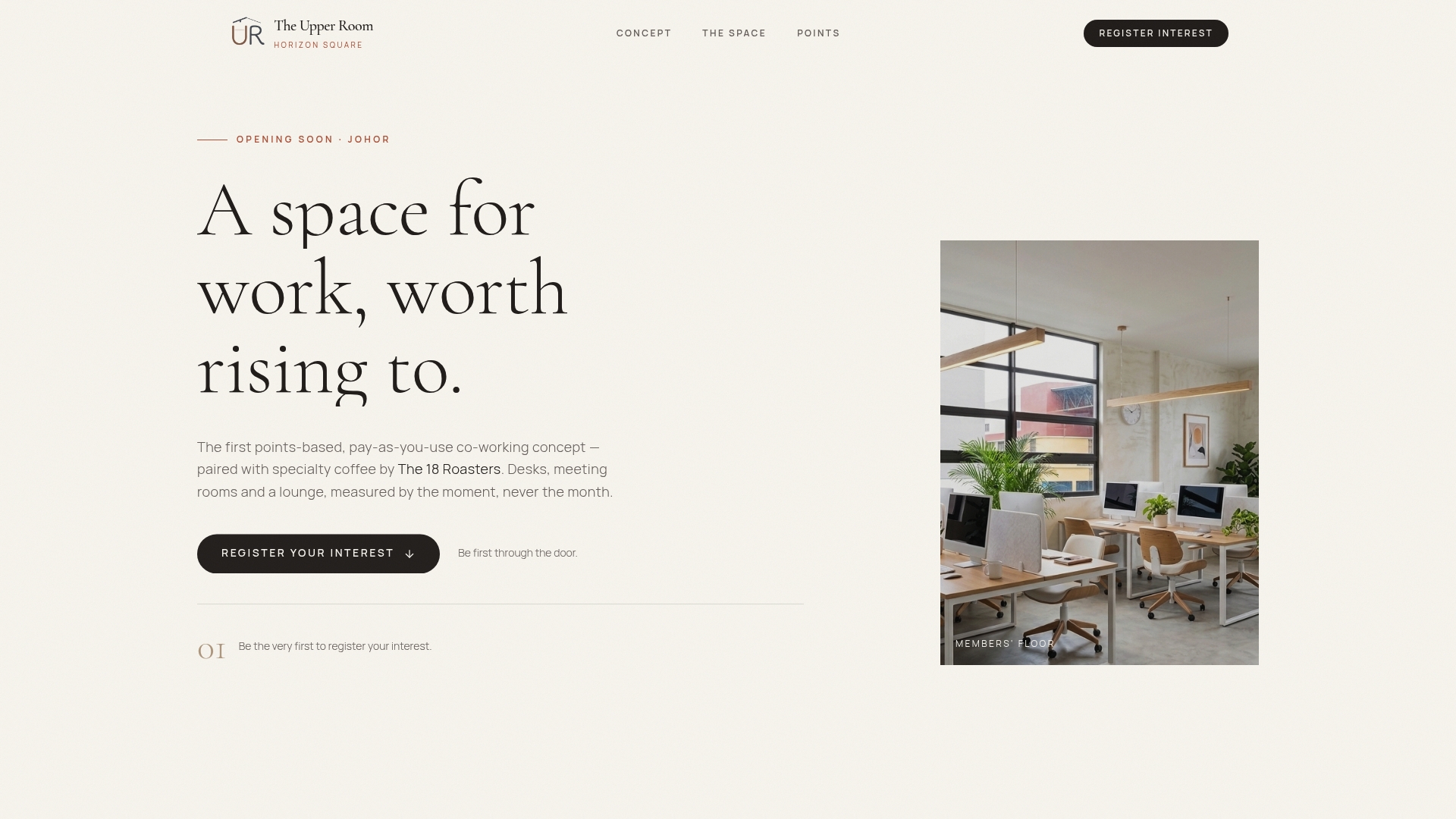
Theupperroom at Horizon Square, Johor operates on a points-based, pay-as-you-use model. You purchase points and spend them on desks, meeting rooms, and specialty coffee from The 18 Roasters. There is no fixed monthly fee and no wasted spend on days you work from home. Members can also host events to earn points back, turning community participation into real workspace credit. Whether you are a freelancer, a remote employee, or part of a small team on a hybrid schedule, Theupperroom gives you a professional environment without the overhead of a traditional office lease.
FAQ
What is the hybrid work policy for Malaysian civil servants?
Malaysian civil servants follow a mandatory 2-day remote, 3-day office schedule effective August 1, 2026, following Cabinet approval in june 2026. Office days align with each state's official rest day schedule.
Can I legally request hybrid work from my employer in Malaysia?
Yes. Sections 60P–60Q of the Employment Act 1955 give employees the right to formally request flexible work arrangements. Employers must respond in writing within 60 days and must provide written grounds if they reject the request.
What tax incentive exists for employers offering flexible work in Malaysia?
Private-sector employers who implement flexible work arrangements qualify for a 50% tax deduction under the government's 2026 incentive scheme. This directly reduces the cost of restructuring office policies.
Is hybrid work suitable for professionals in Johor specifically?
Hybrid work is well-suited to Johor professionals, though the state's Friday-Saturday weekend requires careful scheduling coordination with teams in other states. Coworking spaces in Johor provide professional backup infrastructure for remote work days.
What is the difference between hybrid work and full remote work in Malaysia?
Hybrid work combines scheduled office days with remote days, while full remote work eliminates office attendance entirely. Both fall under flexible work arrangements in the Employment Act 1955, but employers treat them differently when evaluating requests.